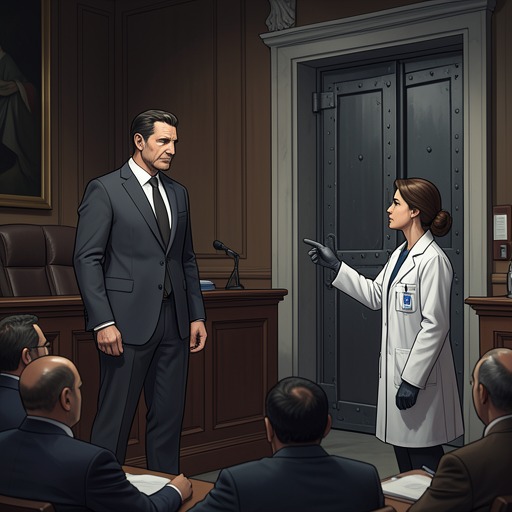
Trial of Lowell Lee Andrews
In Cold BloodThe Trial of Lowell Lee Andrews turned a prosecution for family murder into a contest over what the law should require of a defendant whose understanding remained intact but whose emotional life, according to psychiatrists, was profoundly impaired. Andrews pleaded not guilty by reason of insanity. His defense tried to make the case an occasion for changing Kansas law; the court instead applied the established M’Naghten Rule, and the jury returned the death penalty sought by the state.
Examination and Diagnosis
Before trial, psychiatrists from the Menninger Clinic conducted an exhaustive examination of Andrews. They diagnosed him with schizophrenia, simple type. The term did not mean that he suffered delusions, false perceptions, or hallucinations: the examiners specifically said he had none. They described the central disorder as a separation between thinking and feeling. Andrews understood what he had done, recognized that his acts were prohibited, and knew he could be punished for them. In the clinicians’ account, however, he felt no emotions and regarded himself as the only significant person in the world. Within that enclosed perspective, killing his mother seemed no different in kind from killing an animal or a fly.
The diagnosis therefore presented a difficult distinction for the court. The psychiatric account described a profound impairment, but not a loss of the ability to distinguish legally permitted conduct from forbidden conduct. Andrews’s understanding of the rule and the emotional meaning of his actions were not treated as the same capacity. That gap—between knowing an act was wrong in law and experiencing its human significance—became the case’s central legal problem.
The Defense and the Insanity Standards
Andrews’s defense joined Menninger Clinic psychiatrists with two experienced attorneys. They argued that his condition offered an unusually strong basis for challenging the M’Naghten Rule in Kansas. Under that rule, a defendant was not excused on grounds of insanity if he could distinguish right from wrong in the legal sense, even if his moral or emotional comprehension was impaired. Because the examiners said Andrews understood the nature and prohibition of his acts, their diagnosis alone did not satisfy that standard.
The defense sought to have Kansas adopt the Durham Rule instead. Under Durham, an accused was not criminally responsible when an unlawful act resulted from mental disease or defect. The rule placed the causal relationship between illness and crime at the center of the inquiry, rather than making the capacity to distinguish right from wrong decisive. Andrews’s defenders believed the extensive evidence of his schizophrenia would meet that test and lead to confinement in the State Hospital for the Criminally Insane rather than execution or imprisonment.
The difference was more than terminology. The case put the practical consequences of competing definitions of insanity before the court: whether a person might understand an act’s legal status yet remain so emotionally detached that his responsibility should be judged by a different standard. The defense hoped to turn that question into a legal landmark, replacing the rule that prevailed in Kansas with a more expansive test.
Dameron’s Testimony and the Verdict
The defense’s effort encountered a consequential witness in Virto C. Dameron, Andrews’s former religious counselor and Sunday School teacher. Dameron testified for the prosecution. He recounted warning Andrews that sin carried responsibility before God and that Andrews had acknowledged weak faith and a lack of belief in God. His testimony framed the crime as something Andrews had been urged to recognize as morally grave, and connected the defendant’s prior conversations with the question of whether he understood the wrongfulness of what he had done.
Dameron’s appearance gave religious counsel a direct place in a trial otherwise shaped by psychiatric diagnosis and legal doctrine. The clinicians described a separation of thought from feeling; the counselor’s testimony addressed Andrews’s prior acknowledgment of religious and moral concepts. The book presents that testimony, together with Andrews’s confession, as decisive to the prosecution’s success. The account does not treat the diagnosis as disproved; instead, the court’s outcome turned on the legal standard and the evidence accepted within it.
The judge upheld the M’Naghten Rule, rejecting the change the defense sought. The jury then gave the state the death penalty it had requested. Andrews’s clinical diagnosis thus did not prevent a capital sentence: under the rule applied, the relevant question was not simply whether mental disease was present, but whether the legal test for criminal responsibility had been met.
Place in the Book’s Legal Narrative
The trial appears within a broader account of murder, confession, punishment, and the limits of psychiatric explanation. Its significance lies partly in the sharpness of the distinction it exposes: a diagnosis can describe an extreme disturbance without deciding, under the governing law, whether a defendant is responsible. The defense’s proposed reform and its defeat make the court’s choice of rule visible as a choice with immediate consequences, not an abstract disagreement among specialists.
The verdict also coincided with another unresolved appellate matter. On May 13, the first date set for the executions of Perry Smith and Dick had passed after the Kansas Supreme Court granted a stay while their appeals for a new trial were pending; Andrews’s verdict was then under review by the same court. The juxtaposition places his case among the book’s wider examinations of capital punishment and legal responsibility, while keeping its particular outcome clear: the proposed Durham standard was not adopted, and Andrews received the sentence the prosecution sought.